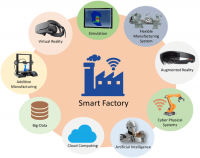
(EMAILWIRE.COM, August 13, 2022 ) According to a new market research report titled, Smart Manufacturing Market by Technology (Robotics, AI, IIoT, Cloud, AR/VR), Application (Machine Inspection, Energy; Quality, and Warehouse Management; Planning, Surveillance, Optimization), End-use Industry, and GeographyGlobal Forecast to 2029, the smart manufacturing market is expected to grow at a CAGR of 21.5% from 20222029 to reach $446.24 billion by 2029.
Download Free Sample Report Now @ https://www.meticulousresearch.com/download-sample-report/cp_id=5265
The growth of this market is attributed to the factors such as the increasing number of government initiatives to promote industrial automation, the rising number of investments in Industry 4.0, growing demand for safety regulation compliance, and high labor costs in developed economies.
In addition, the advent of 5G connectivity in smart manufacturing and the proliferation of smart manufacturing in developing countries are expected to offer lucrative growth opportunities for the growth of this market. However, the high capital and operating expenses and a lack of standardization for technology platforms are some of the major factors restraining the growth of this market.
Impact of COVID-19 on the Smart Manufacturing Market
The outbreak of the COVID-19 pandemic had unprecedented impacts on public health, disrupting industrial structures, halting supply chains, and accelerating social reforms globally. Although the macro challenges, such as disrupted supply chains, decentralized workforce, and the provision of safe and healthy employee workspaces, were different than in past recessions, market players had to deal with monumental market dynamics.
The spread of COVID-19 severely impacted the performance of several industries and economies globally. Governments were forced to shut down manufacturing plants and halted import-export operations. As a result, several industries stopped their ongoing production operations, which disrupted supply chains and affected the demand-supply balance.
The COVID-19 outbreak significantly influenced the manufacturing industry by reducing its dependency on manual labor and highlighted the importance of adopting advanced technologies, such as AI, machine learning, and IoT. Thus, there is increasing adoption of smart manufacturing technologies from various industries in their production processes. The adoption of smart manufacturing has resulted in improved productivity, higher quality, near-zero design error, energy efficiency, leaner process, flexibility in production scale, increased agility, improved predictability, and enhanced process monitoring. These benefits align with the requirement of the new dynamic protocols precedent by the COVID-19 pandemic, influencing the adoption of smart technologies, digital automation, and industrial IoT demand across the industry.
Speak to our Analysts to Understand the Impact of COVID-19 on Your Business: https://www.meticulousresearch.com/speak-to-analyst/cp_id=5265
Smart manufacturing improved companies’ productivity and optimized the workforce required for the same role. It also facilitated remote factory monitoring at greater efficiency irrespective of time and place constraints. It provided the much-required flexibility to the manufacturing units to change the product design and quickly adapt to new processes as per clients’ demands.
Furthermore, the digital twin technology drastically reduced the cost of designing products in a single go. It also offered benefits such as accelerated risk assessment and production time, improved OEE through reduced downtime and improved performance, reduced risks in areas such as product availability and marketplace reputation; new business opportunities through mass customization, mixed manufacturing, small-batch manufacturing, improved product quality and enhanced insights into the performance of products in multiple real-time applications and environments.
Thus, the COVID-19 pandemic positively impacted the smart manufacturing market. It is anticipated that this trend of smart technologies adoption will continue and grow during the forecasted period.
The smart manufacturing market is segmented by technology (robotics & automation, artificial intelligence, industrial IoT, cloud computing & storage, digital twin, industrial cybersecurity, additive manufacturing, blockchain, AR/VR), application (machine inspection & maintenance, quality management, inventory & warehouse management, production planning, surveillance & safety, energy management, resource optimization), end-use industry (automotive, heavy machinery & tools, electronics & semiconductors, aerospace & defense, fast-moving consumer goods, medical devices, food & beverages, pharmaceuticals, paints & chemicals, oil & gas, metals & mining, energy & power, pulp & paper, others), and geography. The study also evaluates industry competitors and analyses the market at the country level.
Based on technology, the smart manufacturing market is segmented into industrial IoT, cloud computing & storage, robotics & automation, industrial cybersecurity, additive manufacturing, AR/VR, digital twin, artificial intelligence, and blockchain. In 2022, the industrial IoT segment is expected to account for the largest share of the smart manufacturing market. The large market share of this segment is attributed to factors such as the consistent declining cost of industrial IoT sensors, the significant rise in the overall equipment effectiveness (OEE) through industrial IoT usage, and the increasing government initiatives to promote digital transformation. However, the blockchain segment is slated to register the highest CAGR during the forecast period. The growth of this segment is driven by the increased demand for blockchain technology in the energy & power and industrial sectors, the increasing demand for real-time data analysis, and the rising need to enhance production with minimum maintenance, simplify business processes, and reduce downtime.
Based on application, the smart manufacturing market is segmented into surveillance & safety, quality management, resource optimization, inventory & warehouse management, machine inspection & maintenance, production planning, and energy management. In 2022, the surveillance & safety segment is expected to account for the largest share of the smart manufacturing market. The large market share of this segment is attributed to factors such as the growing requirement for reliable safety systems to ensure personnel and asset protection, the increasing need for video monitoring in manufacturing facilities, strict government mandates for safety regulations, and the rising need for real-time analysis and tracking. However, the inventory & warehouse management segment is projected to register the highest CAGR during the forecast period. The growth of this segment is driven by the growing need for tracking the movement of goods, increasing manufacturing output due to the adoption of Industrial IoT (IIoT), the growing significance of forecasting models, and the rise in automation for minimizing human interaction.
Quick Buy Smart Manufacturing Market by Technology (Robotics, AI, IIoT, Cloud, AR/VR), Application (Machine Inspection; Energy, Quality, and Warehouse Management; Planning, Surveillance, Optimization), End-use Industry, and Geography – Global Forecast to 2029 Research Report: https://www.meticulousresearch.com/Checkout/30608064
Based on end-use industry, the smart manufacturing market is segmented into automotive, heavy machinery & tools, electronics & semiconductors, aerospace & defense, fast-moving consumer goods, medical devices, food & beverages, pharmaceuticals, paints & chemicals, oil & gas, metals & mining, energy & power, pulp & paper, other (agriculture, prefabricated construction, etc.). In 2022, the automotive segment is expected to account for the largest share of the smart manufacturing market. The large market share of this segment is attributed to factors such as the growth of the automotive sectors post-COVID-19-pandemic, the rising number of investments by automotive manufacturers for automation and development of next-generation automobile warehouses, and the need to reduce costs & downtime in production lines. However, the pharmaceuticals segment is slated to register the highest CAGR during the forecast period. The growth of this segment is driven by the growing need to adopt cost-control measures in the healthcare sector, the adoption of digital technologies in medical device manufacturing operations, and the need to ensure the safety and security of the pharmaceutical supply chain.
Based on geography, the market is segmented into North America, Europe, Asia-Pacific, Latin America, and the Middle East & Africa. In 2022, Asia-Pacific is expected to account for the largest share of the smart manufacturing market. This region is also slated to register the highest growth rate during the forecast period. The high market growth in Asia-Pacific is driven by the increasing deployment of automation across manufacturing units, the rising number of government initiatives for the adoption of industrial robots, the advent of Industry 4.0, and the presence of prominent key players in the region.
The report also includes an extensive assessment of the key strategic developments adopted by the leading market participants in the industry over the past four years (20192022).
The smart manufacturing market is consolidated and dominated by a few major players, namely Amazon Web Services, Inc. (U.S.), Robert Bosch Manufacturing Solutions GmbH (Germany), Cisco Systems, Inc. (U.S.), 3D Systems Corporation (U.S.), Plex Systems, Inc. (U.S.), Cognex Corporation (U.S.), PTC Inc. (U.S.), FANUC CORPORATION (Japan), SAP SE (Germany), Mitsubishi Electric Automation, Inc. (U.S.), Emerson Electric Co. (U.S.), Siemens AG (Germany), Schneider Electric SE (France), ABB Ltd (Switzerland), Hitachi, Ltd. (Japan), and Intel Corporation (U.S.).
To gain more insights into the market with a detailed table of content and figures, click here: https://www.meticulousresearch.com/product/smart-manufacturing-market-5265